
Through the Pressure
A controlled derby, a demanding European night, and a season that continues to develop.

It was supposed to be about both.
Two games, two contexts, two very different demands placed on this Arsenal side. A North London Derby that delivered exactly what it always threatens to, and a Champions League night that carried the weight of a season within it.
But there’s no avoiding where the attention lands.
Because while Arsenal’s 5-2 victory over Tottenham Hotspur was emphatic, entertaining, and at times ruthless, what followed at Stamford Bridge ultimately defines the week.
Still, both matter.
Both add another layer to what this Arsenal side is becoming under Renee Slegers.
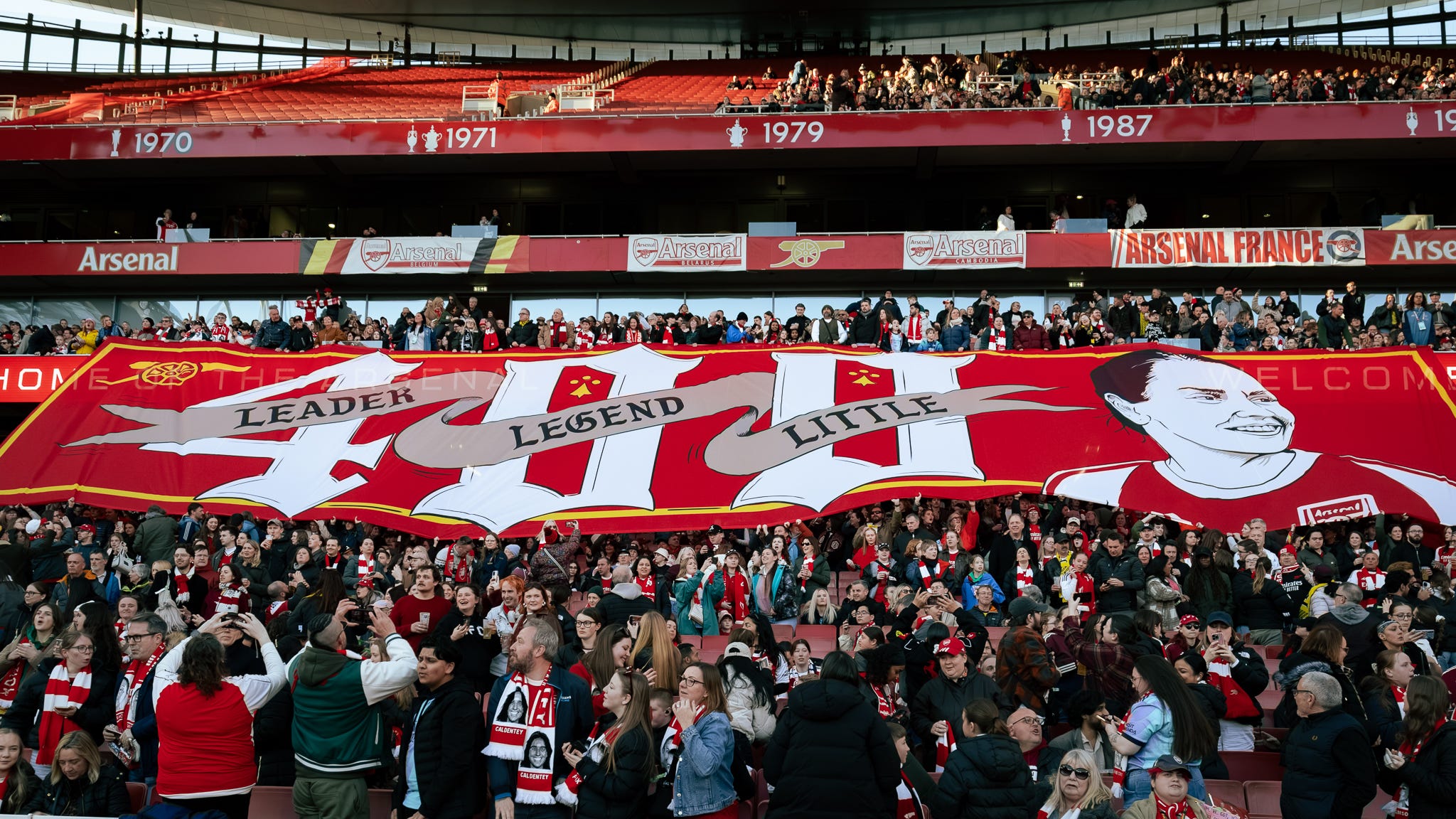
Controlled Chaos in the Derby
The North London Derby rarely follows structure, but Arsenal found a way to impose one anyway.
From the outset, the team selection hinted at both rotation and trust within the squad. Daphne Van Domselaar was preferred in goal over Anneke Borbe, a decision that no longer feels like a hierarchy but rather a reflection of two goalkeepers pushing each other to a level where either can start without concern. Steph Catley returned to centre-back alongside Lotte Wubben-Moy, with Leah Williamson unavailable, while Smilla Holmberg and Katie McCabe occupied the full-back roles.
In midfield, Kim Little and Mariona Caldentey provided the now familiar base, with Frida Maanum operating ahead of them. The front line of Chloe Kelly, Olivia Smith and Alessia Russo carried both fluidity and directness.
Arsenal didn’t just dominate, they created through multiple avenues. The opening phases saw Tottenham Hotspur repeatedly pressed into uncomfortable build-up situations, with Arsenal capitalising on moments where the visitors attempted to play out from the back. That pressure translated into chances, and eventually goals.
Set pieces were one route. Sustained pressure was another. But perhaps most consistently, it was the space in behind that Arsenal identified and attacked. Balls played early, runs timed well, and a willingness to exploit Tottenham Hotspur’s defensive line created a constant threat.
Alessia Russo, at the centre of it all, delivered a performance that reflected both individual quality and structural benefit. A hat-trick built on movement, anticipation and clinical finishing, each goal arriving through slightly different circumstances but all rooted in Arsenal’s ability to destabilise the opposition.
Caitlin Foord, introduced from the bench following her return from the Asian Cup, added a fourth with a finish that felt inevitable given her history in this fixture. There are players who rise to certain games, and Caitlin Foord continues to be one of them against Tottenham Hotspur.
Stina Blackstenius then completed the scoring, her run in behind and composed finish encapsulating the spaces Arsenal had been exploiting all afternoon.
There were, nonetheless, imperfections.
Conceding from a set piece, where Arsenal failed to clear effectively, and a well-taken finish from Bethany England reminded that even in control, there are moments that require sharper management. There were also opportunities left on the pitch, situations in and around the box where an earlier shot may have extended the margin further.
But within the context of a derby, the control Arsenal established across most phases was significant.
And yet, even then, it felt like part of something larger.
A Night Defined by Resilience
There was always going to be noise around this game.
A 3-1 lead from the first leg gave Arsenal control, but not comfort. Chelsea framed it as a comeback opportunity, Stamford Bridge set the stage, and the opening minutes unfolded exactly as expected.
The pressure from Chelsea was sustained, aggressive, and immediate.
They pushed early, attempting to disrupt Arsenal before they could settle, and within that spell, the game demanded something different. Not control in possession, but resilience without it.
Daphne Van Domselaar delivered exactly that.
In a performance that will define her season, and perhaps more, Daphne Van Domselaar repeatedly denied Chelsea at key moments. Not just in volume, but in timing. Saves that prevented momentum from fully swinging, interventions that allowed Arsenal to stay within the tie even as Chelsea dictated large periods.
There had been quiet questions around her selection ahead of Anneke Borbe. Those conversations don’t exist after this.
Defensively, Arsenal were forced into adaptation. Emily Fox returned to the back line, while Taylor Hinds replaced Steph Catley early due to injury and produced a performance of real composure against a difficult opponent. Stina Blackstenius was introduced from the start ahead of Frida Maanum, a decision that aligned with both recent form and the demands of the game.
Because this was never going to mirror the first leg.
Arsenal spoke pre-match about playing the “Arsenal way”, but with the understanding that this does not mean one fixed approach. This was about adapting to context, recognising when control looks different, and staying within the game across ninety minutes.
They did exactly that.
There were moments that could have shifted everything. A late Sjoeke Nusken goal that reignited belief for Chelsea. A disallowed Arsenal goal, where Smilla Holmberg’s delivery found Stina Blackstenius, only for VAR to intervene. Beth Mead striking the post from the bench, inches away from ending the contest.
And then, the closing stages, where game management took over completely.
The ball was worked into the corner, fouls were drawn, and time was slowed wherever possible, every decision made with full awareness of the aggregate scoreline rather than the moment in isolation.
Arsenal lost the game on the night, but won the tie.
And that distinction matters.
From the Stands
To the away support, as I joined you pre-match and then in row 9 of the lower Shed End, that was something else.
From 4pm in the pub through to full-time, there was a constant sense of tension, but also belief. Even when Chelsea pushed and the game felt like it could shift, the noise didn’t drop. And at the final whistle, in a Stamford Bridge that had quickly emptied, it felt like everyone who remained understood just how significant that night was.
The Fine Margins and the Bigger Picture
It would be impossible to reflect on the match without acknowledging the officiating.
The late incident involving Katie McCabe, a pull on Alyssa Thompson’s hair, should have resulted in a red card following VAR review. Katie McCabe acknowledged as much post-match, apologising despite describing the act as accidental. Instead, it was Sonia Bompastor who saw red on the touchline, her frustration reflecting what many inside the stadium felt.
It’s disappointing, not because it defines the result, but because it shifts the discourse away from what was, in reality, a high-level, closely contested European tie.
Because both things can be true.
Arsenal did enough, Chelsea didn’t take their chances, and across two legs, that was enough to decide progression.
What Comes Next
Arsenal now face Lyon in the Champions League semi-finals, a fixture that carries both history and familiarity.
Last season’s encounter remains one of the defining moments of Arsenal’s European campaign. A 2-1 defeat at home overturned by a 4-1 victory at the Groupama Stadium, a performance that ultimately propelled them towards lifting the trophy against Barcelona. Earlier this season, Arsenal lost 2-1 to Lyon in October, but showed enough within that match to suggest the margins are not as wide as results may indicate.
Before that, attention briefly shifts back domestically, with an FA Cup quarter-final against Brighton offering another route to silverware, and another opportunity to build momentum before the international break.
Still Building
At this point in the season, everything tends to get framed as decisive, where each game is treated like it defines what comes next.
But this week didn’t really feel like that.
If anything, it felt like a continuation.
Arsenal are still figuring things out within games and across competitions, moving between control and resistance depending on what’s needed, rather than trying to force one version of themselves onto every situation.
That shift is probably more important than any single result, because it shapes how they approach what’s ahead.
There’s an FA Cup still there, a Champions League semi-final against one of Europe’s strongest sides, and a league position that, realistically, needs to hold.
Renee Slegers has them in a position that feels closer to complete than anything else, with enough in place to keep pushing forward, and that’s what stands out right now.
The end of the Chelsea match with the missed red card diminished the joy of advancing. Issues with referees and VAR need to be resolved. The one change that always comes to mind is two referees on the pitch as is done in hockey. Basketball with its speed of play uses three.
When Mariona and Russo were subbed off in the NDL Spurs were able to increase their intensity. Similar issue when Mariona came off against Chelsea and five at the back was implemented. Something that needs addressed.
Will you be at the Brighton match?
Keep the posts coming!